
Our Story
Berlin’s Only 100% Electric Fleet
A story about taking on decades of monopoly, fighting when it would have been easier to give up — and ending up changing an entire industry.
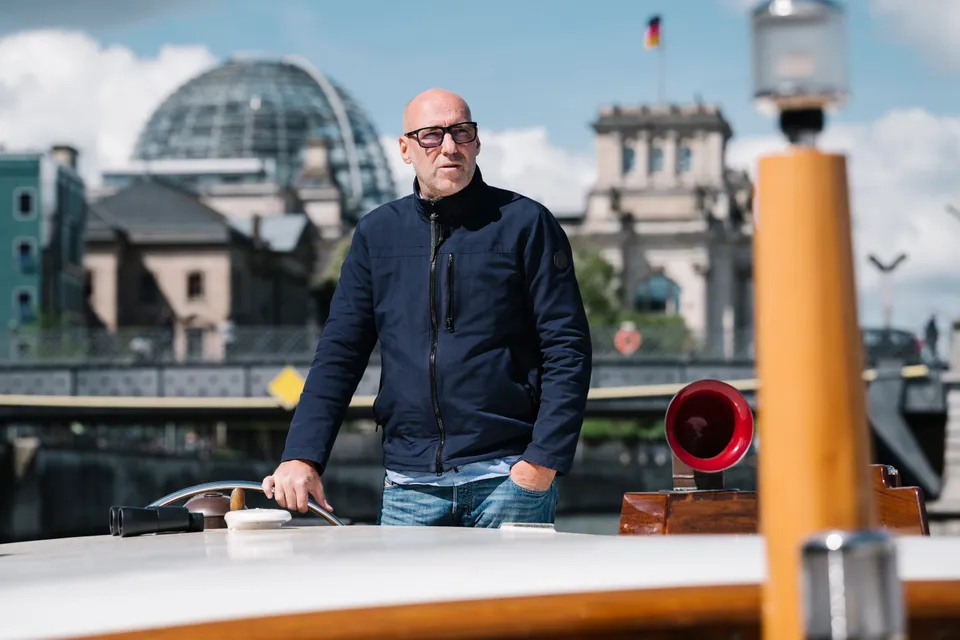
Luis Lindner at the helm of the Fitzgerald — the Reichstag in the background.
“This is purely about keeping competitors with green propulsion out of the market.”
Luis Lindner — Klimareporter°, October 2018
The Decision
Luis Lindner was a management consultant — analytical, successful, a Berliner to his core. Then he decided to do something that mattered more to him than any consulting mandate: convert Berlin's shipping industry to electric propulsion. Not because he had to. Because he thought it was the right thing to do.
What he found was an industry that hadn't moved in decades. Around 100 passenger vessels on the Spree, almost all running on diesel engines from another era — and a system designed to keep anyone who wanted to change things firmly locked out.
A System Built to Resist
Berlin's inner-city mooring points had been leased to two large shipping companies for decades. The contracts renewed automatically, year after year, never put out to tender. No space for newcomers. No space for new ideas. No space for electric boats.
“The mooring points are public property. The fact that private companies can pass them on to their children and grandchildren is simply not legal.”
Together with Germany's nature conservation organisation NABU, Lindner measured the emissions on the Spree. When a diesel ship passed beneath the Friedrichstraße bridge: nitrogen oxide five times the EU legal limit. Fine particulates ten times above safe levels. Berlin's entire passenger fleet was emitting as much soot per day as 120,000 cars — in a city that had long imposed a low-emission zone for road vehicles.
He Fought. Loudly and Persistently.
In 2018, Lindner co-founded the Association for Electric Shipping and Charging Infrastructure — the first organised lobby for clean inland shipping in Germany. He invited members of parliament aboard his boat, wrote to journalists, met with environmental policy-makers, and sued the waterway authority for refusing to process his applications.
“A scarce economic resource allocated by the state to private companies must be put out to tender on a regular basis.”
The media took notice: Tagesspiegel, Der Spiegel, brand eins, B.Z. Berlin, Float Magazin, Klimareporter — they all covered the Berliner taking on an entrenched market. In 2021, Berlin's State Cartel Authority formally opened an investigation into the mooring monopoly.
“Contracts should be put out to tender every five years so that newcomers also get a chance to access the market.”
Lindner had made the system visible. That alone was a victory.
Then He Simply Built What He'd Imagined.
While the investigation ran its course, Lindner didn't wait. At the end of 2021, the M/Y Fitzgeraldwas converted from diesel to full electric propulsion — the first passenger vessel on Berlin's waterways to make the switch. Conversion cost: €200,000, of which 80 percent was subsidised by the State of Berlin. The Fitzgerald began gliding silently along the Spree — no fumes, no engine noise, no emissions.
It was the proof that counted: it's possible. It's affordable. And it's a better experience.
Amsterdam Had Shown the Way
Lindner had always pointed to Amsterdam as evidence that change was possible. Rolf Trijber had fought the same battle there, all the way to the European Court of Justice — and won. Today around 40 percent of Amsterdam's canal boats are electric. Berlin took a different path: not through litigation, but through example. Through quality. Through sheer persistence.
The Result: An Entire Fleet. 100% Electric.
Today FLAGSHIP.BERLIN is no longer a one-boat story. The entire fleet — Fitzgerald, Hemingway, Havanna, Lander, and Express — runs on electric power. No other boat operator in Berlin can say the same. Not one.
What Luis Lindner has built is not a niche project. It is a fully operational shipping company offering weddings, corporate events, sightseeing tours, and dinner cruises — all without a single gram of direct CO₂ emissions. A fleet that proves, concretely and visibly, that luxury and responsibility do not have to compete. They belong together.
“Where this journey is heading, I think, is clear to everyone.”
He was right. And he got it there himself.
The Journey
Luis Lindner founds schoeneschiffe.berlin and starts offering charter trips on the Fitzgerald — still diesel at that point.
NABU emissions measurements on the Spree: particulates ten times above safe levels. Co-founds the Association for Electric Shipping and Charging Infrastructure.
brand eins publishes a full portrait: "On a Collision Course." The monopoly on Berlin's waterways becomes a public issue.
Berlin's State Cartel Authority opens a formal investigation. End of 2021: the Fitzgerald becomes the first passenger vessel in Berlin converted to full electric propulsion.
Major national media coverage. A parliamentary evening on board the Fitzgerald with representatives from all Berlin parties.
The entire fleet — Fitzgerald, Hemingway, Havanna, Lander, Express — runs emission-free. Unique in Berlin.
5
Electric vessels
100%
Zero emissions
#1
Berlin's only E-fleet
2018
Association founded
As featured in
All Articles
- July 2022TagesspiegelA Trip on the Spree is Not Always Fun
- June 2022Float MagazinDirty Air above the Spree
- c. 2022Der SpiegelThe Blocked Energy Transition on the Water
- March 2021B.Z. BerlinCartel Authority Investigates Electric Boat Dispute on the Spree
- February 2019brand einsOn a Collision Course: Electric Shipping in Berlin
- October 2018Klimareporter°Soot Particles from the Spree
- June 2018Binnenschifffahrt OnlineAssociation Fights Against Pollution from Inland Shipping